Whether your childhood was joyful, challenging, or a mix of both, your inner child still walks with you into adulthood, carrying memories, conditioning, and unmet needs. Research in neuroscience and developmental psychology shows how early attachment shapes emotional and social development. How often do we truly honour our inner child? These steps offer a starting point for reconnecting with greater joy and a more intentional relationship with the self.
1. Do something ‘embarrassing’
Free yourself from the shackles of worrying about how other people perceive you. We often take ourselves and life itself too seriously. Life is short, yet somewhere between birth and adulthood, many of us have been conditioned by society, and perhaps those closest to us, to change aspects of our natural selves to fit social and cultural expectations.
One way to reclaim and honour your inner child is by doing things that reconnect you with the parts of yourself you may have learned to hide. “Rejection therapy” has gained recent traction on social media as a practice where individuals intentionally engage in mildly uncomfortable but non-harmful social situations, often finding the outcomes less significant than expected. While some examples are more extreme, such as dancing in a public space, it can also be applied in smaller everyday actions.
For example:
Compliment a stranger
Wear a slightly bold outfit you would normally overthink
Try something new and be visibly bad at it
Eat an ice cream messily in public
Watch a ‘childlike’ or nostalgic film
Walk barefoot in the grass
Skip, run, dance, or sing freely
Often, the strictest rules we follow are the ones we place on ourselves. Lead from the heart and allow yourself to feel slightly silly from time to time.
2. Mindfulness
Slow down and smell the flowers…no seriously… do it.
Many of us spend much of our adult lives focused on what comes next. We may be on a beautiful holiday yet already thinking about the next one, or in peaceful surroundings while worrying about work tomorrow. We often move through life distracted - walking while looking at our phones, thinking about deadlines or tasks waiting for us at home. Life can undoubtedly be stressful, but in doing so, we frequently lose connection with the present moment.
Many people find stillness uncomfortable, yet mindfulness does not have to mean sitting silently in meditation. At its core, it can simply involve becoming more aware of your surroundings.
Children naturally engage with the world through curiosity and observation, noticing details adults often overlook. We may complain about the daily commute while missing the scenery, atmosphere, or small moments within it. Similarly, we often look back at old photographs wishing we could return to that stage of life, forgetting that at the time we were likely focused on wanting the next phase to arrive. One day, we may view our current lives with that same sense of nostalgia and realise there was more beauty in the present than we recognised.
Incorporating mindfulness into everyday life can include:
Colour walks: choose a colour and actively notice it around you to increase awareness of your environment
Five minutes of stillness: no phone, TV, or distractions, simply observe the sounds and space around you
Allow boredom: resist immediately distracting yourself and notice your thoughts and surroundings instead
5-4-3-2-1 grounding: use your senses to reconnect with the present by naming things you can see, hear, and feel
3. Mirror Work - Accepting Yourself, Flaws and All
One of my biggest inspirations is Louise Hay, who popularised the practice of “mirror work”, which uses reflections and affirmations to encourage self-acceptance and self-compassion. Many people find it uncomfortable to maintain eye contact with themselves in the mirror, let alone verbalise something positive. This discomfort can reflect how unfamiliar self-compassion feels for many of us.
Try it: If you have a photo of your younger self, place it on your mirror. Take a moment to say the things your younger self may have needed to hear, or place affirmations on sticky notes around the mirror. From a psychological perspective, this can function as a form of reparenting, intentionally offering reassurance, validation, and compassion to parts of the self associated with earlier emotional experiences.
Louise Hay encouraged people to look at themselves in the mirror and say, “I love you. I really do.” Although this may initially feel uncomfortable or inauthentic, repeated self-affirmation can gradually challenge negative self-perceptions and increase self-directed compassion over time.
You could also try power posing in the mirror - standing in an open, confident posture for a few minutes, which has been shown to foster feelings of confidence and presence in the body.
Why not explore these beautifully illustrated affirmation cards by Louise Hay, known as Power Thought Cards. Designed for daily use, each card is double-sided with a simple affirmation on one side and a more expansive reflection on the other, helping deepen self-compassion and inner strength. The deck includes 64 cards (128 unique pieces of artwork), presented in a gift box.
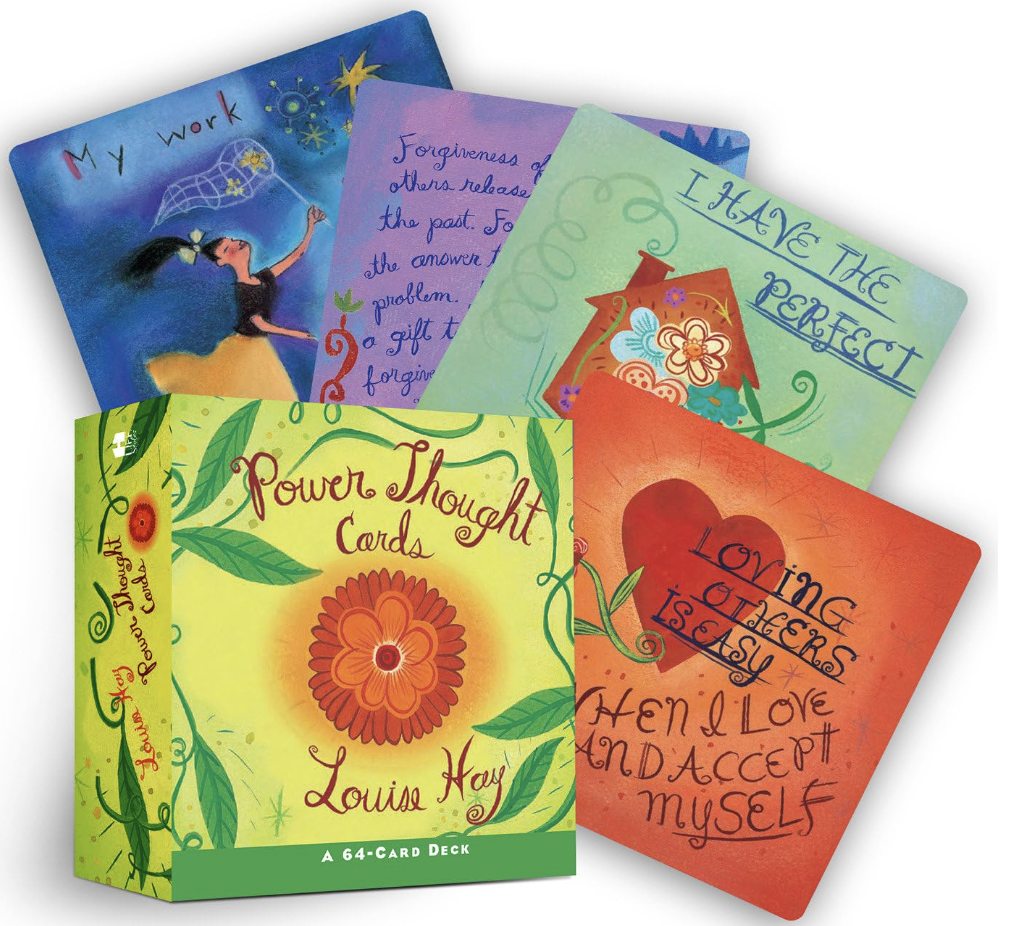
My mum gifted these to me years ago and I still use them frequently to this day! In fact, I loved them so much that I ended up buying a pack for my friend and my sister ended up getting them too.
You can choose a card to focus your intentions on for the day, week or month, or rotate them regularly. I sometimes choose a specific card, while other times I close my eyes and pick one at random, letting my body and intuition decide.
Remember, the more you repeat these affirmations, the more your brain begins to accept them as truths.